Exactly-once is a memory problem
Sooner or later your consumer gets the same message twice.
Not because something is broken. Because at-least-once is what you asked for the moment you decided you’d rather see a message twice than lose it. A consumer dies between doing the work and committing the offset; a producer retries a request whose response never made it back; a rebalance replays a partition from the last commit. Every one of those is the system working correctly.
So the industry sells you exactly-once, and it’s worth being precise about what you’re buying.
What exactly-once actually covers
Kafka’s transactional producer is real and it works. Consume from a topic, transform, produce to another topic, commit the offsets — all in one transaction, all or nothing. Within that boundary, exactly-once is not marketing.
The boundary is the whole point. It holds because Kafka owns both ends: the offsets and the output are in the same system, so they can be committed atomically.
Now put an effect on the other side. Charge a card. Send an email. Call an API you don’t own. Write to a database that isn’t Kafka. There is no transaction spanning that — the external system doesn’t participate in Kafka’s commit, and it never will. The message is delivered at least once, the effect happens at least once, and the guarantee stops at the edge of the system that issued it.
Which turns the problem into a different one:
Not “how do I stop receiving it twice”, but “how do I know I’ve already done this”.
That’s not a delivery question. It’s a memory question.
The primitive that’s enough
The instinct is to reach for coordination — a lock, a lease, something consensus-shaped. You don’t need any of it. Deduplication across nodes needs exactly one thing from your database:
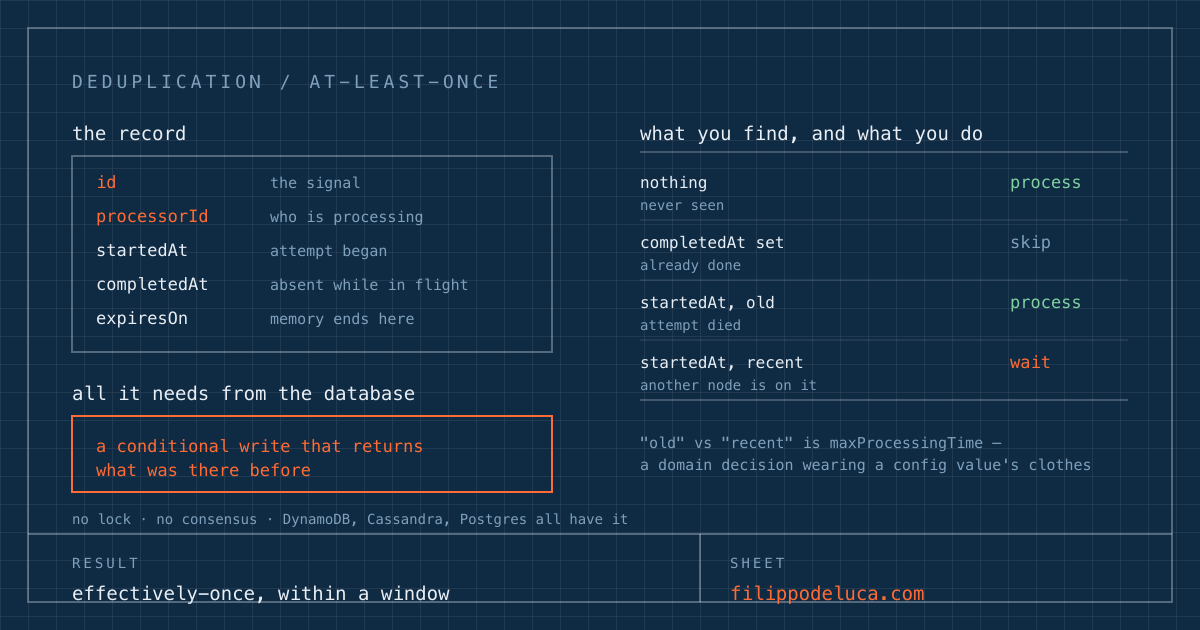
a conditional write that tells you what was there before
An upsert that returns the previous value, executed with strong consistency. That’s it. If two nodes race, both writes land in some order, and each one learns whether it was first. No lock, no election, nothing to time out on.
DynamoDB gives you this — a conditional UpdateItem with ReturnValues: ALL_OLD, on a
strongly consistent write path. So does Cassandra with lightweight transactions. So does
Postgres with INSERT … ON CONFLICT … RETURNING. The pattern isn’t about DynamoDB; it’s
about those two properties, and the shape below works on anything that has them.
Two phases, because the effect can die
Recording “I did this” after the work is not enough — the process can die between the effect and the record, and the next attempt has no way to know. So you write twice: once before, once after.
The record is small:
id           the signal
processorId  who is processing it
startedAt    when this attempt began
completedAt  when it finished — absent while in flight
expiresOn    when this memory may be forgotten
processorId is what lets several consumers deduplicate independently. Two services
consuming the same topic have different processor ids, so both get to act on the message;
two instances of the same service share one, so only one of them does.
Every attempt starts by writing startedAt and reading back whatever was there before.
Four things come back, and each has a different answer:
| What you find | What it means | Decision |
|---|---|---|
| nothing | never seen | process it |
completedAt set | already done | skip |
no completedAt, startedAt old | previous attempt died | process it |
no completedAt, startedAt recent | another node is on it | wait |
The first two are obvious. The other two are where the design actually lives.
The uncomfortable one
Case three — a stale startedAt with no completion — means some previous attempt began
and never finished. Almost always it died. So you retry.
But you cannot tell the difference between died before the effect and died after the effect, before recording it. In the second case, retrying does the work twice.
That window is small, and it is not zero. Which is the honest description of what this buys you: not the elimination of duplicates, but their reduction to a narrow window around process death. If the effect is genuinely dangerous to repeat — money moving — you want it idempotent on the other side too, keyed by the same id. Deduplication and idempotency are complementary, not alternatives, and anyone who tells you they’ve achieved exactly-once end-to-end has quietly assumed one of them.
The parameter that is really a domain decision
Case three needs a threshold: how old must startedAt be before you decide the attempt
is dead? That’s maxProcessingTime, and it looks like a config value while being a
statement about your domain.
Set it too low and you declare healthy-but-slow work dead, and process it concurrently with itself — the exact thing you built this to prevent. Set it too high and a genuinely crashed message sits untouched for that long before anyone retries it.
There’s no safe default, because the right value is “longer than the slowest legitimate run, shorter than anyone’s patience”. Nobody but you knows that number, which is why it shouldn’t have a default at all.
Case four falls out of the same reasoning: a recent startedAt means somebody is working
right now. You can’t process — that’s a duplicate — and you can’t skip, because the other
attempt might still fail. So you wait, and re-read, until it either completes or ages
into case three.
Memory has to end
expiresOn is the part people skip, and then the table grows forever.
You cannot remember every message you have ever seen. So deduplication is always within a window: a duplicate arriving after the record expires will be processed again, and that’s by design. Pick the window from how late a duplicate can realistically turn up — the producer’s retry budget, the replay window of your broker, how far back an operator might rewind offsets — and make it comfortably longer than that.
With DynamoDB, expiresOn as a TTL attribute means the cleanup is free: the table
evicts old records on its own.
Skipping is not always enough
Everything so far assumes that finding completedAt means you’re done: the work happened,
return, move on. For a consumer draining a topic that’s usually right — nobody is waiting
for an answer.
Then you send an email.
You hand the message to a provider — Mailgun, say — and it hands you back a message id. That id is how you’ll correlate the delivery, bounce and complaint webhooks that arrive minutes or days later, and it’s what you store against the record in your own domain.
Now the message gets redelivered. Deduplication does its job perfectly: the email was already sent, so you must not send it again. Correct, and useless — because the code that asked you to send it still needs that id, and skipping hands it nothing.
And the id is not recoverable. You didn’t compute it; the provider did. It exists in exactly one place: the response to a call you have already made and must never make again. Miss it once and it’s gone.
That’s what separates this from caching. A cache is an optimisation — on a miss you recompute and carry on. Here there is no recomputing, because repeating the effect is precisely the thing you are forbidden to do. The only copy of that value is the one you remembered to keep.
So the record has to remember more than the fact. It has to remember the result:
trait Mnemosyne[F[_], Id, ProcessorId, Memoized]:
  def protect(id: Id, fa: F[Memoized]): F[Memoized]
The effect now returns a value, and so does protect. On a first attempt it runs fa and
stores what came back alongside completedAt. On a duplicate it doesn’t run anything — it
hands back what it stored — the Mailgun id, in the example above, without going anywhere
near Mailgun. Deduplication has quietly become memoization.
And here’s the part that makes it nearly free: the conditional write that tells you the signal was already processed is the same one that hands you the stored result. One round-trip either way. You were already reading the previous value to make the decision; the answer rides along with it.
The obvious cost is that now you’re storing payloads, not timestamps, and every constraint that applies to your database’s item size applies to your responses. Big results need a pointer rather than the thing itself.
The less obvious cost is that it changes what your callers observe, and existing tests may
be asserting the old shape without anyone noticing. When I made this change, a test fired
120 concurrent calls to protect(id, IO(1)) and asserted the results summed to 1 — sound
enough when duplicates returned nothing. It came back 120. Every deduplicated caller now
receives the memoized result, so the sum counts callers rather than executions. The
failure was the feature.
The test wanted to check that the effect ran once, and the sum had been standing in for that. With memoization the two questions separate: count executions with a counter, and assert independently that everyone got the same value back. Worth knowing before the same number surprises you in production, where nothing is asserting anything.
What you actually end up with
Not exactly-once. Something narrower, and true:
Effectively-once, within a bounded time window, for a given processor, provided the effect is either fast or idempotent.
Every clause in that sentence is doing work, and every one of them is a decision you made
— the window, the processor id, the processing timeout. That’s more honest than a flag
called exactly.once=true, and rather more useful, because you can reason about which
clause is the one that will break.
The implementation of all this is mnemosyne —
named after the Greek goddess of memory, which is the entire point. It wraps an effect in
protect and runs it once per processor, and it’s about as much code as this post
suggests it should be. The memoized variant above landed first in the
Rust port and is now in the Scala one too.
The interesting part was never the code. It was noticing that the whole thing reduces to one conditional write — and that your database probably already does it.
← Back to all posts